





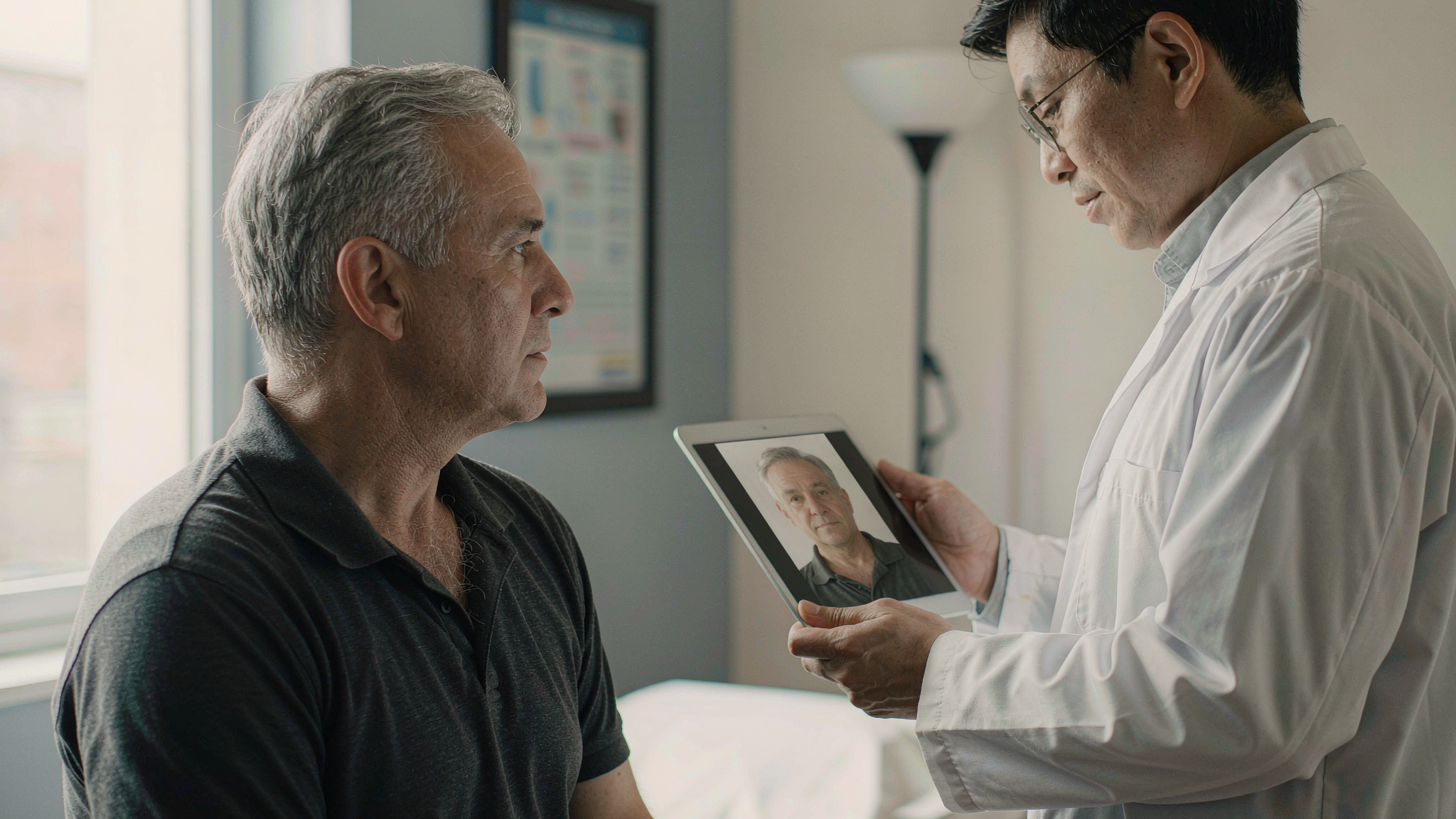
A photo of someone’s face could offer useful information about their outlook after a cancer diagnosis. That is the premise of an artificial intelligence tool developed by specialists at Mass General Brigham, a Massachusetts healthcare and academic system, according to The Guardian.
The system was designed to estimate biological age and predict survival in patients who have already been diagnosed with cancer. Its appeal is easy to understand: a simple image might provide meaningful medical information. But it is important to distinguish what the research suggests from what has been established.
Your birthday does not tell the whole story
Chronological age is the number on your driver’s license. Biological age attempts to capture how much your body has aged. Two people born on the same day can have very different health profiles.
The tool aims to estimate biological age by analyzing a face and also make survival predictions for people with cancer. That does not mean a photograph can detect a tumor: the work described concerns the outlook for patients who already have a diagnosis.
A prediction is not a verdict
For someone undergoing treatment, the word “survival” carries enormous weight. That makes it essential to explain what prediction means in this context: estimating a probability, not knowing exactly what will happen to an individual.
The available summary does not specify how many patients participated, which cancers were studied, or how accurately the system performed. It also does not establish whether the tool improves on standard medical assessments or is ready for widespread use in clinical practice.
Without those details, it would be premature to describe the technology as a ready-to-use clinical test or an alternative to an assessment by a patient’s medical team.
What would make it useful?
If further evaluations confirm its value, a facial photograph could become an additional source of information. The goal would not be to replace medical tests or a patient’s health history, but to determine whether the image adds something that helps clinicians assess that individual more effectively.
- Reliability: researchers would need to understand its errors and test its performance across patients with different backgrounds and characteristics.
- Practical value: generating an estimate is not enough; evidence would need to show whether it improves care.
- Privacy: facial images are sensitive personal data, especially when linked to medical information.
The proposal deserves attention, along with caution. For patients, the most important question is not whether AI can generate a prediction from a photo. It is whether that prediction is reliable and useful enough to help them receive better care.